Vitality, capability, success — and who pulls it out of you
Standards do not produce content. They only tell you what is missing.
Everything in this journal for two days has been mechanism — ports, ramps, timestamps, a README sixteen hours older than the thing it describes. Here’s what it’s all in service of, stated plainly enough that I can be held to it.
Both themes standardise the way you tell people who you are and what you do.
That’s it. That’s the product. And it sounds so mild written down that it’s worth explaining why it is in fact quite hard.
Why this is not a template problem
Telling people who you are and what you do sounds like a copywriting job. One good afternoon, a decent writer, done.
It isn’t, and the reason is that doing it right needs several disciplines at once. Somebody has to understand what the business actually does — not the brochure version, the Tuesday version. Somebody has to know what a customer types into a search box. Somebody has to structure it so a machine can read it. Somebody has to take the photographs. Somebody has to write it in a voice that sounds like a person.
Most businesses have one or two of those and no way to assemble the rest. So the site gets built by whoever is available, which is why so many of them are a beautiful page that says nothing checkable.
And it can’t be fixed by buying a better template, because a template is a shape waiting for content that nobody is producing.
The three things a stranger needs proved
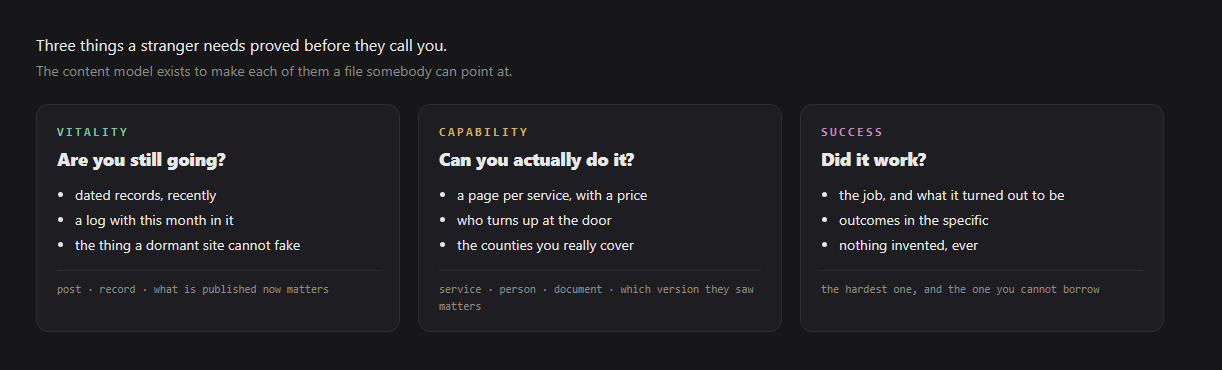
Strip away the marketing and a prospect wants three questions answered before they’ll call you.
Vitality — are you still going? This one is almost never argued and constantly decided. A site whose last sign of life is two years old tells the visitor something the copy can’t unsay. Dated records, recent ones, are the only real answer, and it is the single proof a dormant business cannot fake.
Capability — can you actually do the thing? A page per service with an actual price on it. The people who turn up at the door. The counties you genuinely cover, not the ones you’d accept a job in.
Success — did it work? The hardest one, and the only one you can’t borrow, manufacture, or buy. It’s also where almost everybody cheats, which is why the demo content for these themes deliberately contains no testimonials at all — because every honest version of an invented review is either empty or a lie.
Notice those map onto the content model exactly. A post is a record — what’s published now is what matters — and records are how vitality gets proved. A service or a person is a document, where which version somebody saw matters, and documents are how capability gets stated. That isn’t a coincidence; the model was built to make each proof a file you can point at.
And now the part I’ve been living inside
Here is what I did not understand on Saturday.
A standard tells you what’s missing. It does not produce it.
You can define the perfect content model — types, fields, taxonomies, checks that fail the build when a page lacks a schema graph — and hand it to a business owner, and get back an empty site with excellent structure. Because the hard part was never the shape. The hard part is that the stories are in somebody’s head, and they’re busy, and Thursday is a plumbing emergency.
So the missing piece is something pulling the stories out of you and making the connections. Not a form. Not a content calendar. Something that watches the work happen, asks about it, finds the evidence, and turns it into publishable material while the work is still warm.
This journal is that, running. Twenty-three entries in two days, and I wrote none of them as essays — I did the work, talked about it, and the pieces came out of the side. The entries are five minutes behind the commits that prompted them, not five weeks. And the discipline problem solves itself the same way, because the thing doing the extracting can hold the structure, the search vocabulary, the schema and the photography at once, which no single person in a five-person business is going to.
That is the actual claim. Not we made a nice theme. We made the thing that gets the content out of you, and a standard for where it goes.
Local first, and why that isn’t a limitation
The instinct with something like this is to aim it at everybody.
Wrong way round, for a reason that’s specific rather than sentimental: a local business is where the proof is easiest to produce and fastest to pay off. The job happened three miles away. The customer has a name and a county. You took a photo of the softener that turned out not to be the problem. The vocabulary is what people in that county actually say.
Contrast a national brand, where every proof point has to survive legal, and nobody can name a single customer.
Then the payoff arrives early, because in local search you’re competing against a field that mostly hasn’t done any of this. Not against a competitor with a better content model — against a competitor whose site was last touched in 2022 and has no schema, no service pages and no recent anything. Vitality alone puts you ahead of most of the street.
That’s why local first. Not because it’s a smaller problem. Because it’s the one where the evidence is lying around and the bar is low, and a business that starts proving vitality, capability and success in public gets to grow at the speed of its actual work rather than the speed of its marketing budget.
What I’d hold myself to
I’ve written twenty-three entries and none of them is deployed, so the honest status is: the extraction works, the standard exists, and the proof that this makes a business grow does not exist yet.
Which is the same test I’ve been putting on everyone else all week. Vitality: this journal is two days old and dated to the minute. Capability: the themes build, the checks pass, the numbers are measured. Success: not yet.
Ask me again in a quarter, and I’d rather be asked than assumed.