Presence, platform, product
A website is not a business. It's a third of one.
I believe every local business needs to build three things, in this order.
Presence. Platform. Product.
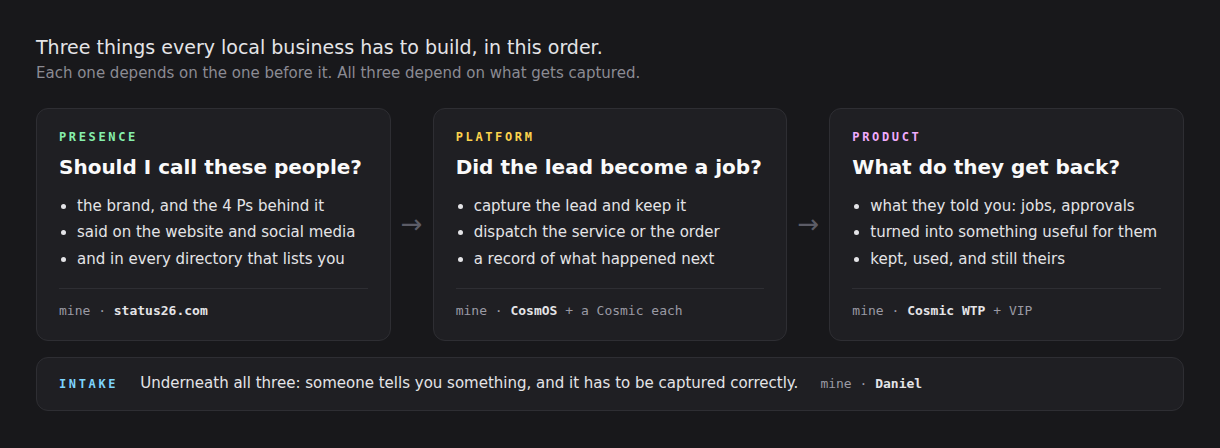
That sounds like a slide. It started as a voice note, and I want to explain it properly, because for most of my career I would have told you the list had one item on it.
What I used to sell
I spent about twenty years selling local search. Websites, speed, content, listings. All of it is presence, and for a long time I treated presence as the whole job: get the business found, make the phone ring, and whatever happens after the phone rings is somebody else’s department.
Reasonable. And wrong.
Because the phone ringing is where the business actually starts, and what happens next decides whether any of the marketing was worth paying for. A lead that lands in a voicemail nobody checks, or a web form that emails an inbox nobody reads, is a lead you paid for and threw away.
A website is not a business. It’s a third of one.
Presence is the brand, said everywhere
Presence is your brand, communicated. Strictly speaking it’s the old marketing 4 Ps — product, price, place and promotion: what you sell, what it costs, where you do it, and how people hear about you — said consistently everywhere a customer might look. Your website. Your social media. And the directories: Google’s business listing, the review sites, every place that prints your name, phone number and hours whether you asked it to or not.
Yes, one of the 4 Ps is also called product. Hold that thought. It isn’t the same product I mean at the end.
Presence answers one question for a stranger: should I call these people? It’s the part almost every business has started, and the part almost every agency will happily sell you more of.
Platform is everything between the call and the truck
Platform is everything you need to capture a lead and dispatch the work — a service visit or an order.
That’s the form that actually saves what someone typed. The record of who they are and what’s wrong. The handoff into whatever schedules your crew, so that a request at nine on a Sunday turns into an arrival window on Monday instead of a sticky note. And the record afterwards of what happened, so nobody has to remember it.
None of that is glamorous and none of it shows up in a portfolio. It’s also where most of the money leaks out, quietly, a lead at a time.
Product is what their data lets you do for them
The third one is the one I didn’t have a word for until recently.
Product is what you can do to create value for your customers once they trust you with their data.
Not the thing you sell. The thing you can do because you know something about them: their address, their equipment, what went wrong last time, what they were quoted and what they approved. A business that holds that and does nothing with it has a filing cabinet. A business that turns it into something useful for the customer has a product.
This is the marketing P coming back round. Presence describes what you offer. Product is what you can offer only after somebody has told you who they are.
Mine, so you can hold me to it
I’d be a hypocrite to argue this and not show my own three. All of them are live or running, and none of them is finished.
Presence: status26.com. Status26 is my company, and the new site went up this month. It introduces our local growth platform and the service brands that run on it, with one invitation covering all of them, and it has case studies from the work so far.
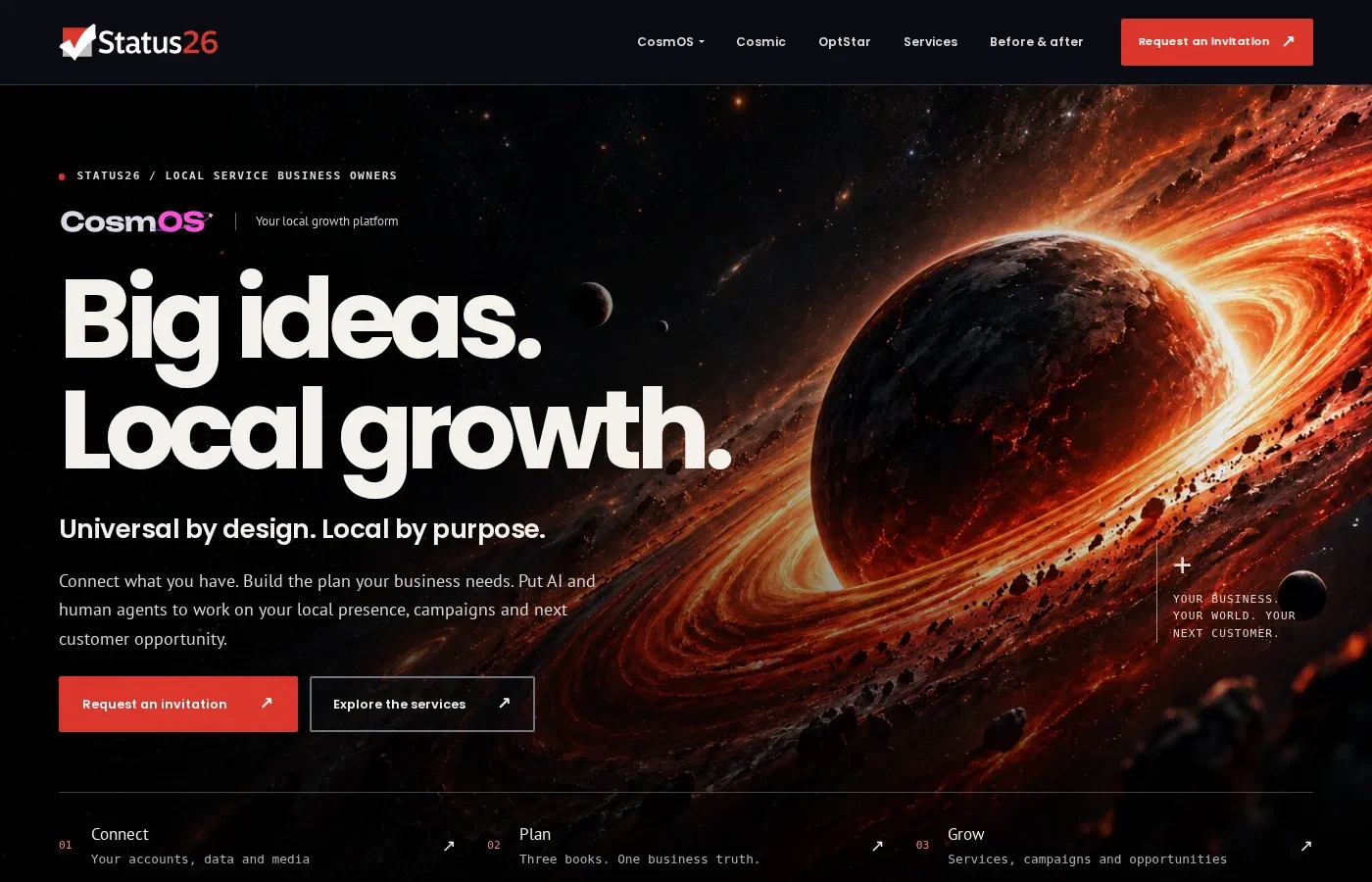
The detail I like most is on its Cosmic page: status26.com is itself a Cosmic. The presence runs on the platform it’s selling, which is the only honest way I know to sell a platform.
Platform: CosmOS. CosmOS is the platform under all of it. It connects a business’s information, its service delivery, the AI and human agents doing the work, and the opportunities the marketing creates. Each business gets a Cosmic, its own instance, where the data, media and business knowledge we collect from its existing accounts and ongoing intake live. The owner works through Oasis, a control plane on their own domain: see the connections, approve the plan, follow the work, receive the leads.
Two pieces of it are public, if you want to read rather than take my word. LEBOSS (repo) is the open standard CosmOS is built to: local business data ownership, access, audit, portability and revocation, written down as rules so a vendor can be held to them. Lucky is CosmOS’s credential custodian, the piece that holds a customer’s keys in a vault, puts them where the work needs them, and proves they still reach the systems they’re for.
Product: Cosmic WTP. The Cosmic I built for We The Plumbers, a Marine veteran-owned plumbing company in Conroe, Texas, serving Montgomery County.
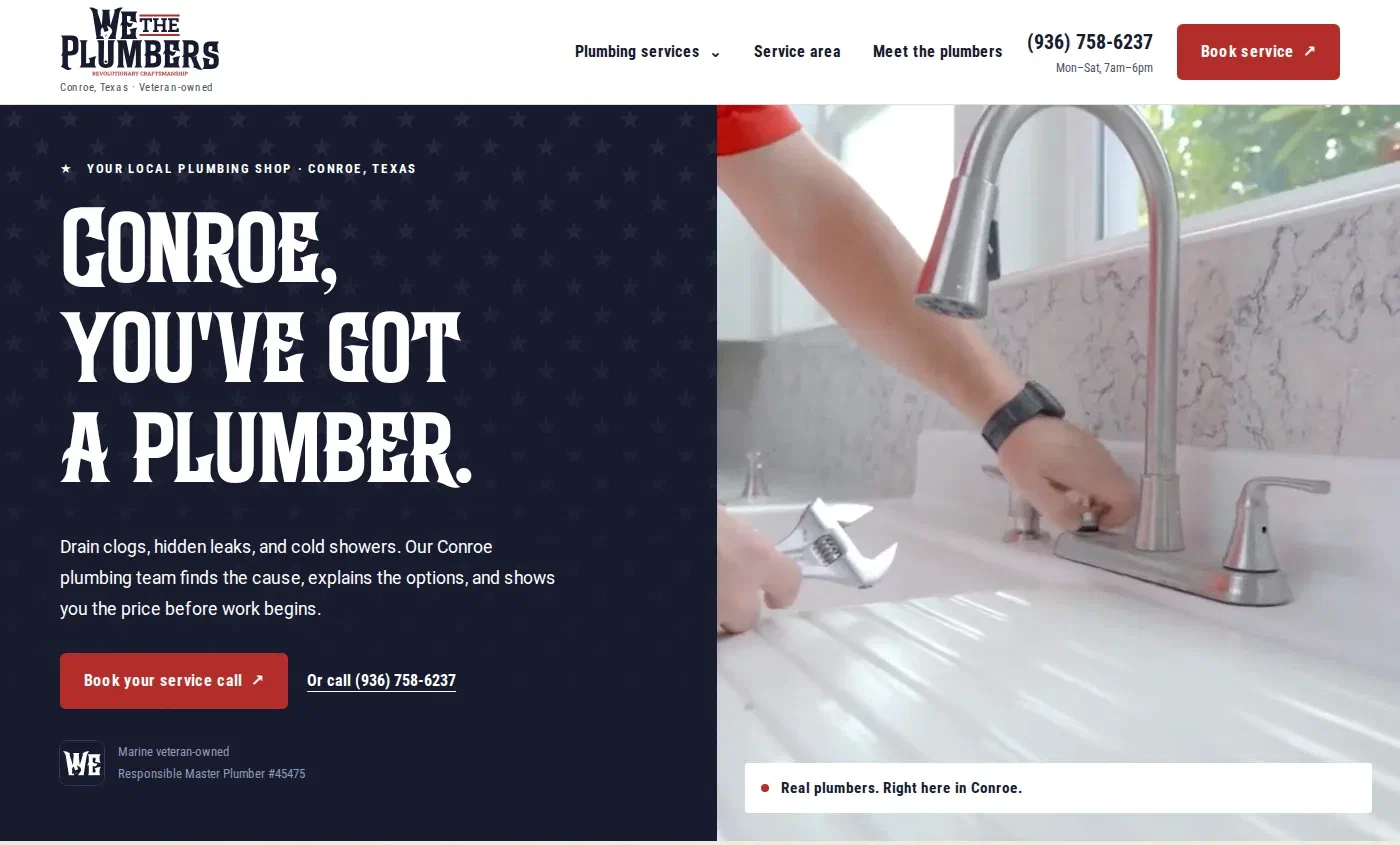
The public side is a site organised around what a customer actually notices (a slow drain, a leak, no hot water) that leads to the service they need and then to one place to request a visit. Behind it is a back office called VIP, and VIP is the part I’d point at. That’s where the owner signs in, sees the requests the site captured, and makes the calls about pricing instead of leaving them in an email thread. I won’t show you the inside. It’s their business, and that’s rather the point.
None of it works without their data: the service catalog, the photographs of their own crew, the records of how the work actually gets done. They handed that over, and what came back is something they can use. Which is exactly the third P.
And the thing underneath all three
Every one of those starts the same way: someone has to tell you something. A customer describes a leak. An owner explains what they charge for a water heater. I describe a business model into a microphone.
That’s intake, and it is the foundation, because everything after it is only as good as what got captured.
So the last piece is Daniel, a voice tool I’m building. You talk, and it shows you two things side by side: what you said, word for word, and what you meant to say, cleaned up by AI so you can check it, edit it and send it. The first release ran on my own machine this weekend; the web app in the picture below is the next one, still a local build.
How generously it has to read is the funny part. This entry started as dictation, and the transcript of me saying Cosmic WTP came back as “cosmic debt.p. Wtb”. We The Plumbers came back as “wii the plumber”. Every word of the idea was in there. Not one of the names survived.
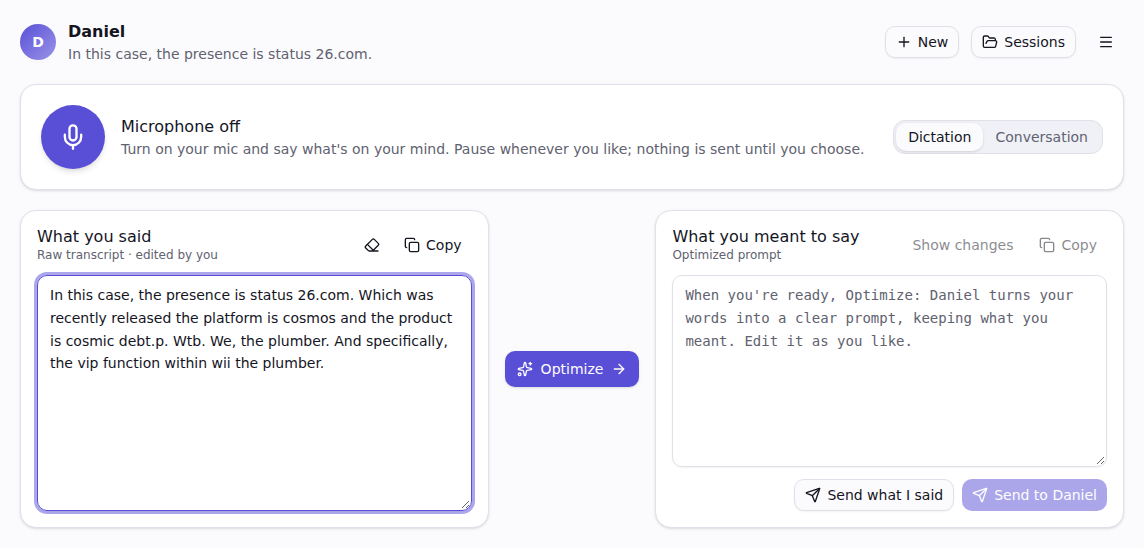
That is what intake looks like before anything helps it, for a plumber taking a call from a panicked customer just as much as for me. The words arrive. The meaning has to be pulled out of them.
Three questions for your own business
Presence: if a stranger searched for what you do in your town this afternoon, would every place they landed agree on who you are, what you charge, and when you’re open?
Platform: when a lead arrives at nine on a Sunday, where does it go, and who knows about it by Monday morning?
Product: what do your customers already tell you, and what are you doing with it for them?
If you can only answer the first one, you’re not behind. You’re where nearly everybody is, and where I was for twenty years.
But a website is not a business. It’s a third of one.