Four releases for the person before the business had one
The pulse of the brand comes from the owner's spectrum.
If you have ever gone back to something you wrote a few weeks ago about your own plan, and found it describing a plan you no longer have —
yes. That one. Let’s talk about that.
What I would have told you yesterday
I have two Hugo themes. A theme, if you haven’t met one, is the design layer: it decides what a page looks like and leaves the writing alone.
Spectrum is the one this journal runs on. Pulse is the one status26.com will run on. And until this morning I could have told you confidently how they related, because I’d written it down in Spectrum’s own README back when I started it:
Spectrum is the presentation half of Pulse. Spectrum carries no content types, no taxonomy and no URL structure; those belong to the site.
Clear. Confident. Two halves of one thing — Pulse the site, Spectrum the skin it wears.
Then I built Pulse
It isn’t that. Not even close.
Pulse has its own layouts/, its own content/, its own config. It does not
reference Spectrum anywhere. It is not a site wearing Spectrum; it is a
second, complete theme sitting beside the first.
They’re siblings, and they’re split by who they’re for:
| Theme | For | Site |
|---|---|---|
| Spectrum | the owner, building a personal brand | jwogrady.com |
| Pulse | the business entity | status26.com |
So that README is a fossil, and here is how I know rather than merely suspect: it links to a repository that did not exist when it was written.
The README was last edited at 22:32 UTC on the 20th. hugo-pulse was created
at 15:02 UTC on the 21st — sixteen and a half hours later. The sentence
describing how Pulse and Spectrum relate was written before Pulse was a repo.
That makes it a statement of intent, not a statement of architecture, and the distinction is the whole finding. A project’s own documentation is evidence of what somebody meant at the time of writing. It is not evidence of how the thing currently works, and nothing in the file warns you which one you’re reading.
Worse, for me: that last edit was mine. I opened the file the night before to add a section about a new feature, and walked straight past a false architectural claim two paragraphs above where I was typing. I wasn’t reading the README. I was editing it.
That’s the part worth sitting with. It wasn’t a thing I’d forgotten — it was a thing I was sure of, in writing, in my own repository.
The order is the interesting part
Here’s what I didn’t expect to find when I went looking at the dates.
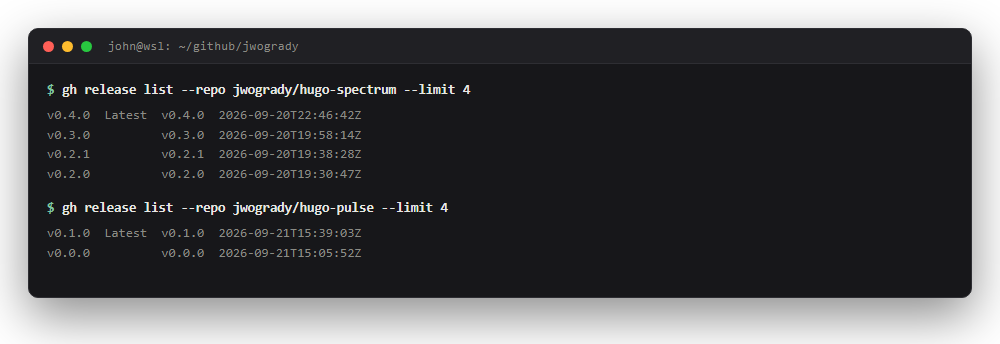
Spectrum hit v0.2.0, v0.2.1, v0.3.0 and v0.4.0 across the 20th. Pulse’s
first commit is 9006a10, at 14:58 UTC on the 21st — about sixteen hours
after Spectrum cut v0.4.0. Its first release, v0.0.0, lands at 15:05.
Four releases for the personal brand before the business brand had a single commit.
Now, I’d written the rule down weeks ago, before either theme existed: do the personal brand first, because before you can build a brand outside of you, you have to build one for the person who is going to do it.
So my first draft of this entry said the timestamps had caught me obeying my own doctrine without consulting it. Nice line. Wrong.
Because the real reason is more practical and more interesting, and I only said it out loud later:
I would have created pulse first, since pulse is where I need to found the base content types, taxonomy, and media specifications for every client we sell. However, I also needed to capture pulse in the making, so I had to build spectrum first.
I wanted to build the business theme first. It’s the more valuable one — it’s the foundation every client site inherits from. I built the personal one first because the personal one is the thing that records, and I needed it running before there was anything to record.
The instrument had to exist before the experiment it measures.
Four releases for the person before the business had one — and not because I was being principled about it. Because you can’t photograph a build you haven’t got a camera for.
For a while I thought that gave me two competing explanations — a principle and a logistics problem — and that I’d have to pick one and admit the other was a story I told afterwards.
They’re the same explanation. It just took saying it out loud to hear it:
The pulse of the brand comes from the owner’s spectrum.
That’s not wordplay on two repository names. It’s the architecture. A business’s output — its cadence, the thing that makes it look alive from outside — is generated by the person running it. Their range, their obsessions, what they keep noticing, what they can’t stop working on. That’s the source signal. The business is the part you can see from a distance.
Which means the doctrine was never a moral position about self-investment, and the logistics constraint was never separate from it. I had to build the recorder before the thing it records, and the reason the recorder belongs to the person rather than the company is that the person is where the signal comes from. Same fact, stated twice, in two vocabularies.
What I think this actually means
Two things, and the second one is why I’m writing it down.
Your documentation of a decision decays faster than the decision does. The README wasn’t lying when I wrote it. It went stale because the work moved and the prose didn’t, and prose has no way of knowing. So: check a document’s date against the date of the thing it describes. If the doc is older, you are reading a plan. Mine had no date on it at all, which is the cheapest thing in this entry to fix and the one I’d fix first.
And the bigger one. The reason personal-brand-first isn’t just self-indulgence is that the business brand is built by a person, and that person needs somewhere to think. Spectrum isn’t a warm-up for Pulse. It’s the place I work out what I believe, in public, at my own expense, where getting it wrong costs nothing but my own time. Pulse inherits every one of those lessons already paid for.
That holds well outside websites. The side project before the pitch. The practice deck before the client deck. The letter you write and don’t send. You are the cheap environment. Use yourself as the staging server, and send the business the version that already survived contact.
Go look at something you wrote about your own plan a month ago. Just go look.