Filed under the name of the work, not the name of the question
Nothing was missing. It was filed under the name of the work that produced it.
Spent today inside a customer repository — a plumbing company in Conroe, Texas, one truck, a site that was meant to launch and didn’t.
The owner’s answer to what’s actually stopping you was: the voice. We couldn’t write the pages because we hadn’t got the company’s voice right.
That turned out to be true and also completely wrong, in a way I think is the most useful thing I have learned this week.
What the voice guide said
The repository has a ten-document knowledge pack. Document five is
05-Brand-Voice-Guide.md. Here it is, in full:
Honest, local, educational, community-oriented.
Four adjectives. The same four every plumbing company in Texas would pick. You cannot write a headline from that, which is precisely why nothing was getting written.
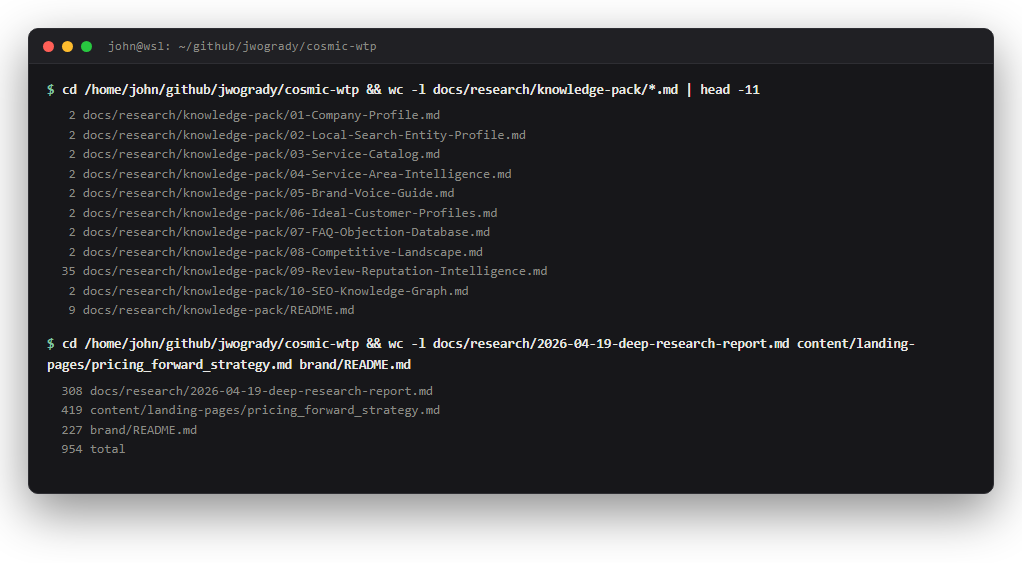
Nine of the ten documents are two lines long. One has content.
Where the voice actually was
Three places, none of them called “voice.”
In the reviews. The one completed document analyses 79 reviews, all five stars, fifteen months. Its top finding:
“Dean” by name — 30 mentions. The technician is the brand — customers review the person, not the company.
Twenty-eight of the fifty-one written reviews name a specific man — Dean Stewart, technician of record on sixty of the seventy-nine jobs. That is not a brand attribute somebody chose in a workshop. It is what happened, counted.
The document says thirty. Recounting the export gives twenty-nine mentions across twenty-eight reviews. Close enough not to matter, wrong enough to make the point: the one document that looked finished still had to be checked against the file it came from, because it shipped the count and not the counting.
And it explains the four adjectives. The same document notes that customers' own words — honest, professional, friendly, fair — match the voice guide’s pillars almost exactly. The adjectives weren’t wrong. They were the summary of the evidence, with the evidence deleted. That is why they generate nothing: a conclusion with its working thrown away cannot be reasoned from.
In a file called pricing_forward_strategy.md. Filed under
content/landing-pages/, which is where you would look for copy, not for a
voice guide. It opens:
Plumbing customers have a specific fear: “What will this cost?” They call around because they don’t know if $199 is cheap or expensive for a drain cleaning.
That is a described customer experience — a person, a fear, a behaviour. It generates copy immediately, and three landing pages were written from it. The method worked. It just isn’t stored anywhere a person would look for a voice.
And in a 36 KB research report filed by date. It contains a five-competitor
benchmark with sources, and the finding that not one of them publishes a real
flat-rate menu. The knowledge pack’s 08-Competitive-Landscape.md — two lines
— is that report, unmoved.
The pattern, which is the entry
Nothing was missing. Everything was filed under the name of the work that produced it, rather than the name of the question it answers.
The competitive analysis is filed as a research report. The voice is filed as a copywriting strategy. The brand definition is filed as a directory README. The reviews analysis is the one document that happens to sit where somebody would look, which is why it was the only one that felt finished.
An index of questions and an index of projects are different indexes, and nobody builds the first one because the second one happens automatically.
What the numbers say about the old site
While I was in there I found the search data, extracted three weeks ago and never used.
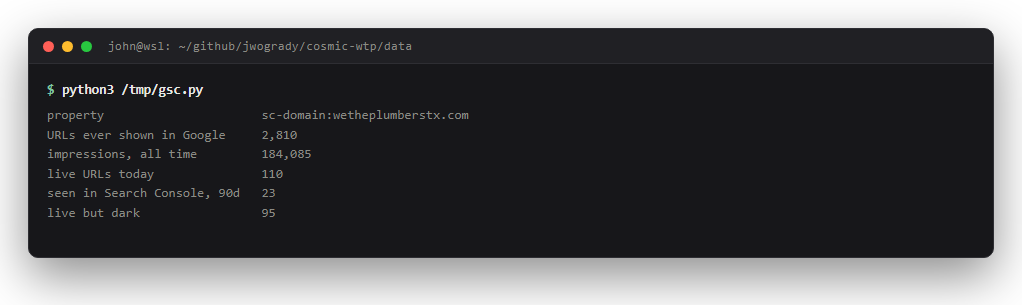
2,810 URLs have been shown in Google for that domain. 184,085 impressions. 110 pages are live today, 23 have appeared in Search Console in ninety days, and 95 are live and dark.
Most of those 2,810 came from a page-per-query campaign — effective hard water solutions crossed with every neighbourhood and county in the region. 776 of them follow that exact shape and their median lifetime impression count is seven.
But they were not all worthless, and this is the part that surprised me. Four of the five highest-earning pages the domain ever had are from that same campaign — emergency sewer backup in named neighbourhoods, five thousand impressions each. The generator found real demand about a dozen times out of two thousand attempts, and nobody went back to see which dozen.
That is a better argument against content grids than “they don’t work.” They work occasionally, at a rate that makes finding the winners impossible unless you measure — and the measuring is the part nobody does, because the whole appeal was not having to think.
If you run a business, this is the thing
You have already paid for the answers to most of the questions you are stuck on. They are in a consultant’s report from two years ago, a file your designer sent, an email thread where somebody explained the thing properly once.
They are filed under what they were, not under what they answer. So when you go looking, you search for brand voice and find a document called brand voice containing four adjectives — while the real answer sits in something called a pricing strategy, because that was the project that needed it.
Before you commission anybody to work out who your business is, spend an hour writing down the questions you actually need answered, then go looking for each one by hand. My honest guess is that half are already answered somewhere, and that the half that aren’t is a much shorter brief than the one you were about to pay for.
And the voice of this plumbing company, in the end, is not four adjectives. It is a man called Dean Stewart, named in twenty-eight of fifty-one reviews by customers who were never asked to.