Evidence Storytelling
The story is a byproduct of the work, not a second job.
If you run a business and you have ever thought we should really be writing about this, and then not written about it for eight months —
this one’s for you. I’ve been you. I’m partly still you.
Here’s the thing I want to put a name to, because we built it this week and it works: Evidence Storytelling.
The problem, stated plainly
Every business is told to produce content. Every business owner knows why they don’t.
It isn’t that writing is hard. It’s that writing happens after. You do the work — you fix the thing, you win the account, you find the bug that cost you a week — and then at some point later, in some other mood, you’re supposed to stop doing work and go reconstruct what happened well enough to be interesting.
Two things go wrong there, and they’re both fatal.
You’ve forgotten the good part. The detail that made it a story — the wrong thing you believed for twenty minutes, the exact number, the moment it clicked — is gone within a day. What survives is a summary, and summaries are boring. That’s why so much business content reads like a press release: it is a reconstruction, written by someone who no longer remembers being confused.
And it’s a second job. One nobody’s paying for, competing with the work that is. It loses. It should lose.
What we built instead
The narration happens while the work happens, and it’s automated.
I talk while I’m working — direction, frustration, what I just found out. That gets captured as it’s said. The system then goes and collects the actual evidence: the real commands and their real output, the commits, the file sizes, the screenshots of the thing on screen. It writes the piece from that evidence, in a documented voice, and it refuses to publish anything it couldn’t back with an artifact.
That last part is the whole reason it’s called Evidence Storytelling and not just writing. Nothing in a piece is allowed to be plausible. If a number appears, a command produced it. If a screenshot appears, it was taken, not described. If a claim can’t be backed, it gets marked unverified in the ledger rather than smoothed into the prose.
Why I believe it rather than hope it
Because the timestamps don’t leave room for anything else.
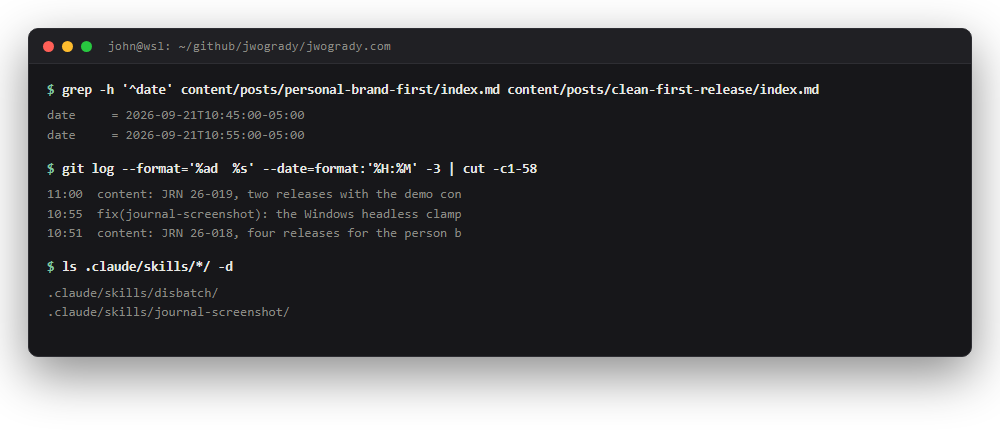
Two entries from this morning, dated 10:45 and 10:55. The commits that shipped them: 10:51 and 11:00. The writing is five minutes behind the work, not five weeks.
Twenty entries now exist, covering two working sessions. Every one carries a timestamp to the minute and a citation code that resolves to a permanent address. I did not sit down and write twenty essays. I did the work and talked about it, and the pieces came out of the side of that.
The story is a byproduct of the work, not a second job.
The two products, and why there are two
Same engine, two audiences, and the split matters commercially.
Spectrum is the personal one. It’s what this site runs on — the individual owner, building a personal brand, in public, at their own expense. That’s deliberately first, and not out of vanity: the business brand gets built by a person, and that person needs somewhere cheap to be wrong. Spectrum is the cheap environment.
Pulse is the same engine for a business entity. It hit its first two releases this morning. Its first real deployment is Rise Local.
For a partner or a co-founder, here’s the shape of that: the expensive part of content isn’t the publishing, it’s the sustained attention. Evidence Storytelling moves the cost from attention to setup. You pay once to wire a brand’s capture and voice, and after that the brand produces a record because the people in it are doing their jobs. It scales the way infrastructure scales, not the way a content calendar scales — which is to say, it doesn’t need a heroic person in the middle of it every week.
What is not proven, because you’d want to know
I’d rather you heard the gaps from me.
Nothing is measured yet. There’s no analytics, no attribution, nothing that says whether any of this is read. The loop I described — capture, publish, measure, decide — is missing its last stage, and I know it.
Nothing is published yet. Twenty entries, all drafts. The voice is close and it isn’t mine yet, and I’d rather ship late than ship a version of myself I don’t recognise.
Pulse is two releases old. Rise Local is the intent, not yet the deployment.
So this is a working workflow with a proven capture stage and an unproven business case. That’s the honest position, and it’s the one I’d want if the roles were reversed.
For anyone starting something
Here’s the part that costs you nothing and works today, independent of any of our tooling.
You are already producing the evidence. You’re just throwing it away.
Your commits, your invoices, your calendar, the three messages where you worked out what the client actually wanted, the screenshot you took to send your business partner. That’s the raw material of every story your business will ever tell, and most people delete it or let it scroll away, and then sit down months later in front of a blank page and try to remember being interesting.
Start keeping it. Not neatly — keeping it is enough. Date it. The narrative comes later and it comes easily, because the hard part was never the writing. The hard part was being there, and you already were.