Day one: the stack, and why each piece earns its place
If the publishing step has a login screen in it, I'll stop writing.
I’m writing this one before I’ve built anything, which is deliberate. The things that are about to cost me an hour will be obvious and unmemorable in a week, and obvious-and-unmemorable is exactly the knowledge I keep having to buy twice.
So: notes while I’m inside it, not a tidy retrospective afterwards.
The stack
Hugo, because the build is one binary. No Node toolchain underneath it,
nothing to npm install, nothing to rot in six months when I come back to
this.
Zed, because it’s quick in the way that changes how you work rather than the way that shows up in a benchmark — no gap between keystroke and glyph, no pause opening a large file. The configuration surface looks wide enough that I expect to lose an afternoon to it, and I’m oddly looking forward to that.
WSL, with everything in the Linux filesystem rather than straddling the
/mnt/c boundary.
All three answer the same requirement: I want to write in an editor I already have open, commit, and have that be the whole publishing step.
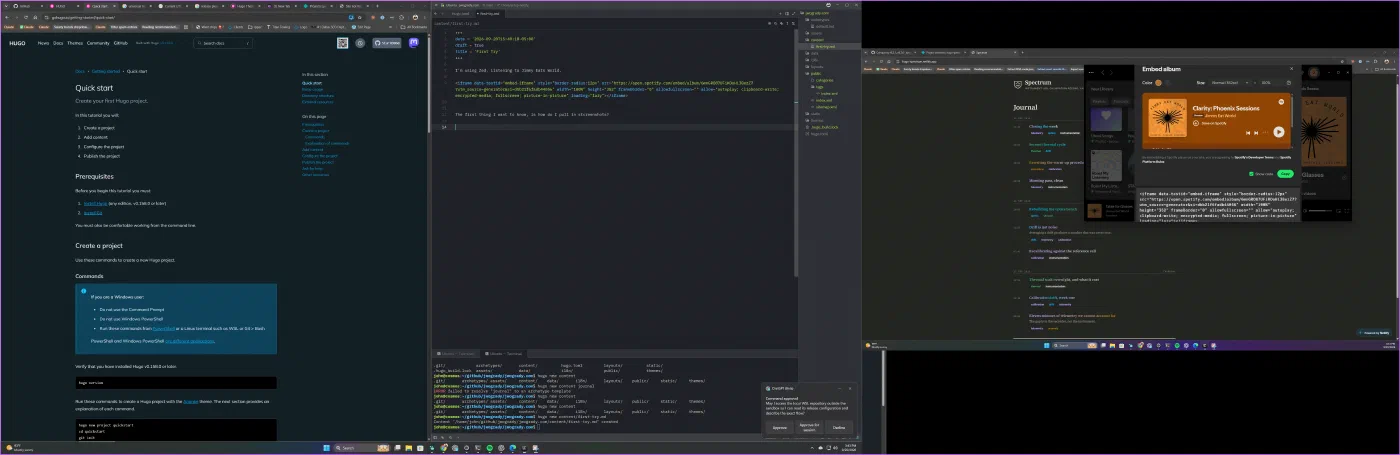
What’s playing
What I expect to get wrong
Hugo’s directory conventions, mostly. I have a rough idea what content/,
assets/ and layouts/ each do, and no real model of how they differ — which
is precisely the kind of gap that produces an hour of confusion and one
sentence of explanation.
Let’s find out which sentence.