Close enough, or known
Local is not one claim on a geography. It is two, and only one of them is a radius.
Local means near.
That is the first thing anyone learns about marketing a local business, and it is load-bearing. It is why you buy a radius on a map, why you write a page for every town within forty minutes, why people in this trade say “near me” out loud without embarrassment. Distance is the axis. Everything hangs off it.
We were two rounds of revisions into naming the kinds of local business before anybody noticed that it is only true of some of them.
The job looked clerical. A new repository — localpromoter, a set of
reusable skills for building websites for the sort of business that used to
buy a yellow-pages ad — needed to say who it was for. Not a positioning
exercise. A README. Sort local businesses into types so that every skill
written afterwards knows which type it is written against.
Three types fell out easily, because they are the three you would draw yourself with a pen and a napkin:
- The shop. A restaurant, a garage, a retail floor. Call it a Fixed Location Business — FLB. The location is the service.
- The van. A plumber, an electrician, an HVAC contractor. A Service Area Business — SAB. Nobody comes to them; they drive.
- The office. An insurance agent, a bank, a lawyer, a telehealth practice. A Professional Service Business — PSB.
Names assigned, boxes drawn, job done. Except the axis underneath all three was still wrong, and that is the part worth writing down.
The theory I held confidently, for two revisions
All three were sorted by distance.
The first draft had the professional office down as a business whose value is being close to the customer — local knowledge, local relationships, being from around here. Reasonable. It even sounds true. It is exactly the kind of sentence that survives a review, because there is nothing in it anybody can point at and call wrong.
Then three examples turned up at once: insurance, banking, telehealth.
An insurance agent licensed in a state serves that state. The licence is the boundary, not the odometer. A bank’s market is defined by charter and footprint. A telehealth practice serves everyone inside a jurisdiction and is physically near almost none of them. None of those businesses get smaller when you drive further from their front door — and one of them may not have a front door in that market at all.
John’s line, which is the hinge the whole thing turns on:
the difference is the gap between local proximity and local awareness
Two claims on a geography
Proximity is being close enough. Distance is a real constraint on who you can serve. Run out of road, run out of customers.
Relevance is being the business that a geography is aware of and identifies with. Distance constrains nothing. Standing does.
That is the split, and once you have it the three types stop being three boxes and start being two claims:
FLB is pure proximity. The customer travels. The market is a driving-distance radius, the currency is foot traffic, and the site’s job is to make the trip feel worth taking — address, hours, directions, parking, confidence on arrival.
SAB is proximity manufactured by driving. The provider travels instead. Which means the service area doubles as the marketing reach: the same map that says who you can serve says who you should be advertising to. One boundary, two jobs.
PSB is relevance. The market is drawn by licensure, jurisdiction and local fluency, not by miles. Being nearby earns nothing. Being known earns everything.
Three conversion events — a visit, a job, an appointment. Three bounds — a radius, a territory, a market.
Close enough, or known.
The one nobody warns you about
Here is the case that made the whole thing worth a README.
A professional services business with no physical presence in the market it serves is the hardest local business there is to market and to rank. There is no address to verify. No map pin to earn. None of the proximity signals that local search algorithms lean on, because every one of those signals is a measurement of a distance you do not have.
Everything has to be carried by relevance: jurisdiction, local track record, market-specific knowledge, locally grounded content and citations. Plan for a longer ramp and a heavier content burden than a shop or a van in the same market, and do not let anybody sell you otherwise.
And the cruel part is that from the outside it looks identical. Both have an address somewhere. Both run what any agency would call a location-based marketing plan. The plan looks the same on the surface; the reason it works is different, and if you copy the shop’s plan onto the office’s problem you will spend a year defending a radius that was never the constraint.
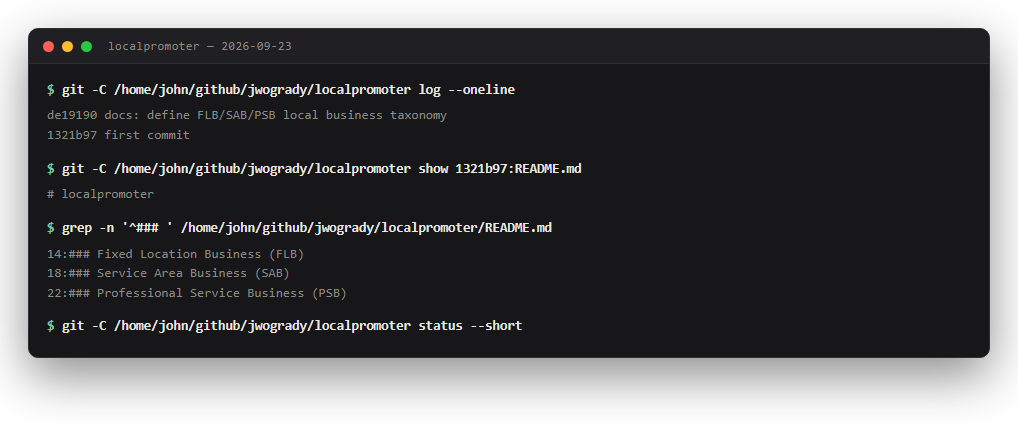
That card is the honest state of this. Two commits. A one-line README this morning, three types this afternoon, nothing else in the repository yet. No campaign has been run against this classification and no ranking has moved because of it. It is a way of seeing, written down and dated — which is the only kind of claim I can make about it today.
If you run a business, this is the thing
Before you spend the next dollar on local marketing, answer one question and be honest about it:
Am I selling close enough, or am I selling known?
If you are a shop, distance is your constraint and your enemy is friction — make the trip obviously worth it. If you are a fleet, your service area is doing double duty as your ad budget, so draw it deliberately rather than letting it sprawl wherever the last job was. And if you are selling something where the customer never travels and neither do you — advice, cover, money, care at a distance — stop buying proximity. You cannot win it. What you can win is being the name that market has heard of, and that is bought with time and evidence rather than with a radius.
Same map. Two completely different things to be.